
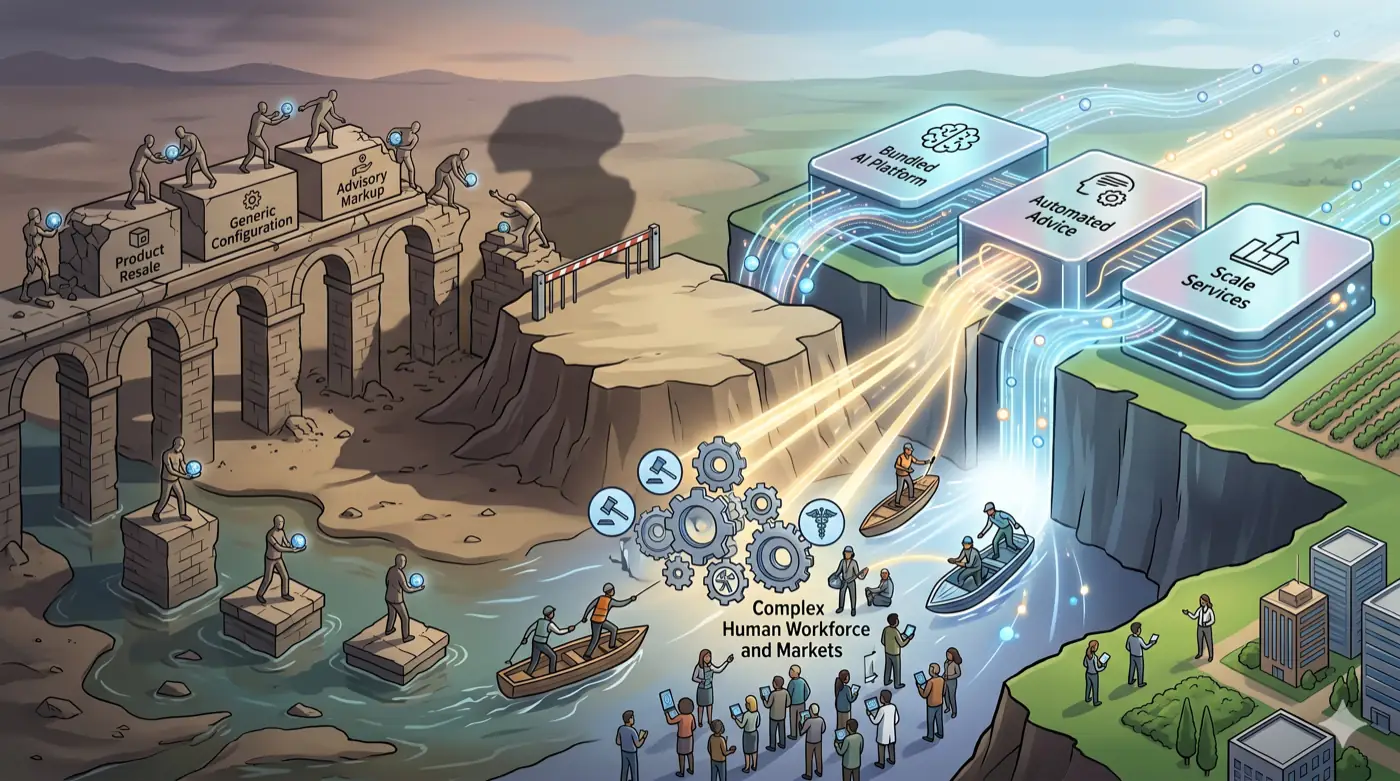
Our last article laid out the first pressure: the AI hyperscaler landscape has reorganized into competing infrastructure alliances, and a channel partner's economics now depend partly on which side of the compute-cost line its customers sit. This conclusion still holds. The durable ground for channel partner monetization is workflow consequence, not technology access. This article looks at a second movement, underway in parallel, that is easy to misread as an attack on the channel and is better understood as the value chain itself being redrawn.
Within twenty-four hours of each other, OpenAI and Anthropic stood up their own services arms. OpenAI's deployment company raised more than $4 billion, anchored by TPG, at a reported valuation of around $14 billion. Anthropic launched an enterprise-services venture valued near $1.5 billion, with Blackstone, Hellman & Friedman and Goldman Sachs behind it. Combined, that is roughly $5.5 billion directed at the deployment and consulting layer. Read alongside the hyperscalers bundling AI into the platforms customers already buy, the commodity layers of the old channel model (product resale, generic configuration, the advisory markup) are steadily being absorbed into the platform itself. Both movements are set out in our 2026 Channel Forecast.
A Rational Move, Not a Hostile One
It is tempting to read hyperscaler alliances as the platforms turning on their partners. We believe that framing is both wrong and unhelpful. A platform owner that can deliver more of the value chain at scale, at near-zero marginal cost, has an obligation to its shareholders to do exactly that. Bundling AI into the product and standing up services capacity is not a betrayal of the channel; it is competent platform economics. Treating it as a betrayal leads to the wrong response: defending a layer that is disappearing instead of moving to the one that is opening up.
The more important point is what the same logic pushes the platforms away from. Scale economics pull a hyperscaler toward the average customer and the repeatable workload. They pull it away from the messy, low-volume, high-liability work: jurisdiction-specific compliance, the non-obvious process logic of a particular vertical, the last mile of a mid-market deployment where someone has to answer for the result. Hyperscalers build platforms, not professions. Their own AI products create deployment and accountability gaps they have neither the structure nor the appetite to fill. In the value chain now forming, they need a channel to occupy that layer. We believe they need it more than they did before.
Three Moves, One Direction
The pattern is not confined to two labs. Read alongside what the hyperscalers are doing inside their own platforms, the message is clear: as the platform captures the scalable layer, the value left for partners moves up.
| Player | The move | The logic behind it |
|---|---|---|
| OpenAI | A deployment company with more than $4B raised; engineers working inside customer operations | Capture more of a value chain it already sits at the center of |
| Anthropic | An enterprise-services venture valued near $1.5B; applied engineers building alongside clients | Make sure its model turns into adopted, working deployments |
| Google, AWS & Microsoft | AI capability bundled into the platforms customers already buy, at near-zero marginal cost | Serve the average customer at scale; leave the non-average to partners |
How the Value Chain Is Being Redrawn
The cleanest way to see the shift is to ask, layer by layer, who captured the value before and who owns it in the chain now forming.
| Layer of value | Who captured it before | Who owns it in the AI-era chain |
|---|---|---|
| Product & license access | The channel, via resale margin | The platform, bundled in |
| Generic configuration & advice | The channel, billed by the hour | Automated or self-serve inside the platform |
| Workflow outcome & accountability | Rarely owned by anyone | The channel: the layer the platform will not stand behind |
| Vertical & jurisdictional depth | A partner differentiator | The channel's moat: where platforms structurally will not go |
Why This Reaches the SMB-to-Corporate Market
The headline tactics (embedded engineers, private-equity-portfolio relationships) are aimed at the largest enterprises. A partner whose customers sit in the SMB-to-Corporate band, from small business up through roughly $1 billion in revenue, might read all of this as someone else's problem.
It isn't, but not because anyone is coming for those accounts hostilely. The platforms reach the SMB-to-Corporate market the same way they serve everyone, through product. Self-serve agents, bundled platform intelligence, and one-click deployment now do, natively, much of what a mid-market customer once needed a partner to configure and support. That is the platform serving the average customer well. The opening for a partner is precisely the inverse: the average customer is who the platform serves best, and the specific, regulated, accountability-bound customer is who it serves worst. An SMB-to-Corporate partner already lives among the second kind.
Where the Channel Adds Value Now
The value chain now forming still needs partners, just in a different place than before. The platform wants its AI adopted and succeeding in accounts it cannot serve intimately; a partner who will own the outcome makes that AI work where it would otherwise stall. That aligns the two rather than pitting them against each other. The partner brings what the platform lacks: proximity, domain depth, and a willingness to be accountable for a result. The platform brings cheap, capable intelligence the partner could never build. They are complements in the new chain, not rivals for the same dollar.
How to build that position is the work of the articles that will follow: staying model-sovereign across ecosystems, concentrating in verticals where accountability outranks cost, and rewriting commercial terms around outcomes rather than access. This article's job is narrower: to reframe the shift correctly. The platforms are not removing the channel. They are removing the parts of the old channel model that no longer create much value and leaving open the part that creates the most. Partners who move into it will find the platform an ally. Those who defend the old layer will find it closing beneath them.
Part of a series
This post is one part of the Insights series, our post-by-post working through of the thesis the 2026 Channel Forecast sets out in full.
Sources
- Reporting on the OpenAI and Anthropic services ventures and their private-equity backing: The Information, Bloomberg, CNBC, Reuters, TechCrunch, Crunchbase.
- Private-equity portfolio distribution and AI services economics: Bain & Company, Global Private Equity Report 2026.