
Our regular readers will remember we have long predicted the death of the billable hour, and it is now clearly taking its last gasps in public. McKinsey now ties about a quarter of its global fees directly to client outcomes rather than hours, a shift significant enough that, as the Financial Times has reported, the firm is overhauling partner pay around it. Boston Consulting Group is pushing the same way. Less diplomatically, and this is our own read: this is not a philosophical shift, it is an existential scramble to find a new way to make money as AI destroys the old one. When the largest firms in the highest-margin corner of professional services start dismantling the billable hour, its fate is not in doubt.
The direction is easy. The mechanism is where you can get hurt. The same reporting notes the quiet part: many firms trying to move to outcome pricing lack the cost controls to do it safely, and putting fees at risk against the wrong result is how a good idea becomes a bad quarter, or worse. For a channel partner, the last article argued the operating model has to shift from building to operating. This one is about the commercial model that has to sit on top of it, and about the single distinction that decides whether outcome pricing pays you or buries you: the difference between intent and execution.
Intent Is What the Customer Wants. Execution Is What You Control.
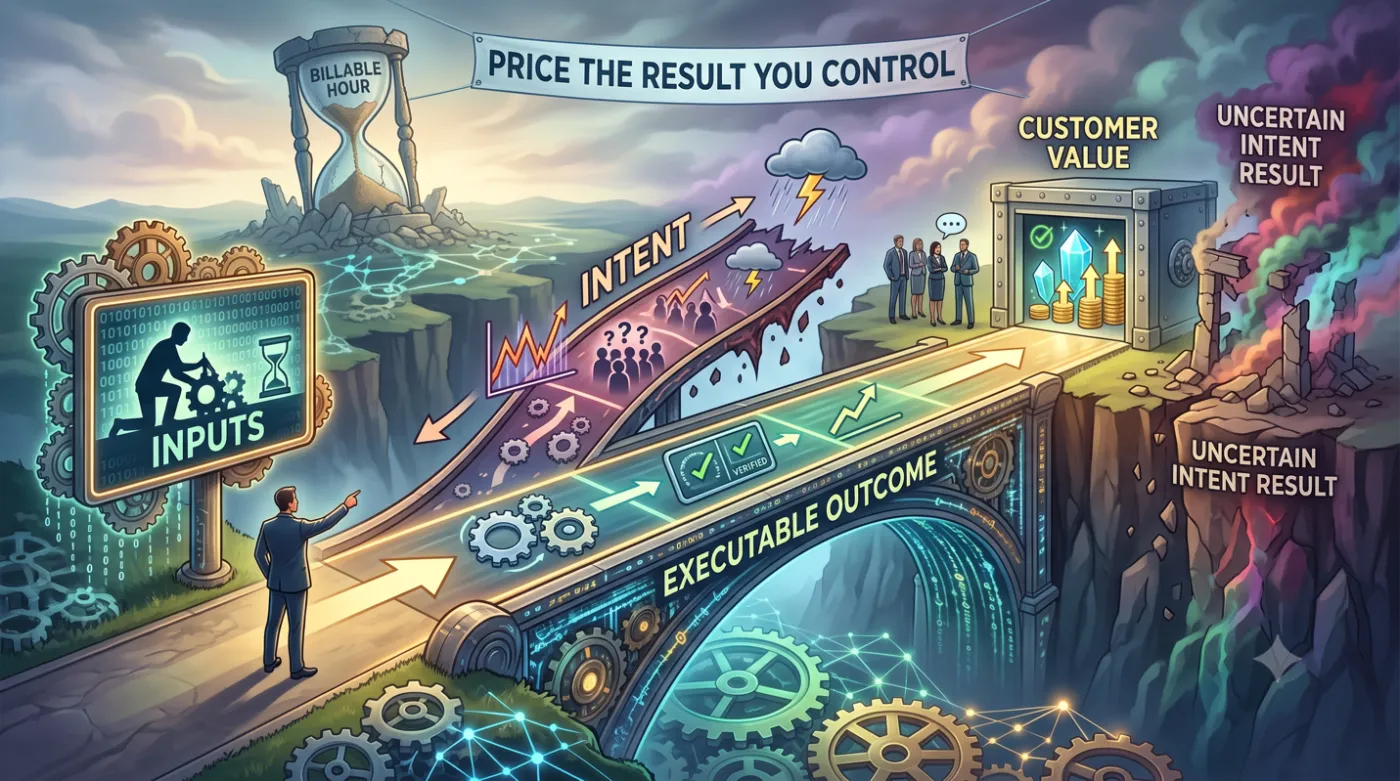
Every outcome a customer cares about has two layers. There is the intent, which is the business result they actually want: revenue up, cost down, churn lower, an error rate cut in half. And there is the execution, which is the work you actually perform and can stand behind: the workflow runs, the output is correct, the operational metric moves. These are not the same thing, and the gap between them is where money is won or lost.
You control execution. You do not fully control intent. A workflow can run flawlessly and the revenue can still not move, because the customer did not act on the output, or a competitor cut prices, or the market turned. Intent depends on a dozen things that have nothing to do with whether your agents did their job. The temptation in outcome pricing is to sell against intent because that is what the customer wants to buy. The trap is that you would be putting your fee at risk against a result you cannot govern.
Why Pricing the Intent Blows Up
Price against intent and you have not sold a service, you have sold a bet, and one where the house does not control the dice. This is precisely the cost-control problem the major consulting firms are running into. A fixed or at-risk fee tied to a business result assumes you can predict both what it costs you to deliver and whether the result will land. Get either wrong and the contract that looked like premium pricing becomes unpriced liability. Firms that have run outcome pricing well for years, a few have done it since long before AI, succeed because they are ruthless about scoping the outcome to something their work actually determines. The ones now scrambling are discovering that accountability you cannot control is not a business model, it is exposure.
Price the Executable Outcome
The way through is to price the executable outcome: the operational result that sits at the seam where your control meets the customer's value. Not the raw activity, which is just the billable hour in new clothing, and not the far-off business result you cannot govern or audit, but the measurable thing in between that you can stand behind and that reliably drives what the customer is really buying: a support-resolution rate, a clean-migration completion verified by telemetry, a documented reduction in processing errors, a claim adjudicated correctly the first time. Structure the fee against that, with a band for over- and under-performance so the upside and the downside both have a floor and a ceiling.
This is why outcome pricing does not mean the partner disappears into a black box. As one McKinsey partner framed it, outcome pricing acknowledges that judgment still belongs to people while adding a level of accountability the profession has traditionally avoided. You are paid for the result, and you are paid because you were the one who could produce it. The metric is chosen so that hitting it is both within your power and worth real money to the customer. That choice, more than the pricing model itself, is the whole craft.
The Cost Side of the Bet
There is a cost to being precise here, and it is the one our earlier article on token governance flagged. When you put a fee at risk against an outcome, your margin is the outcome's value minus what it costs you to deliver, and under an agentic contract the largest variable cost is inference, the workforce's wage bill. If that cost is volatile, every outcome contract is quietly also a wager on a number you do not set. A fixed fee for a fixed result, running on a token bill that can swing with a model change or a price move, is a margin you cannot forecast.
That is the unglamorous reason outcome pricing is safest where the underlying cost of intelligence is both low and predictable. A partner delivering on an integrated stack, where the silicon and the model sit under one owner and the price of inference moves in one place rather than across two or more vendors, can commit to a fee-at-risk contract with more confidence than one whose cost curve is assembled from parts it cannot see. It does not decide which ecosystem a partner uses. It does decide how much of the outcome's value survives as margin once the meter has run, and that is worth knowing before you sign.
Why This Reaches the SMB-to-Corporate Market
The SMB-to-Corporate customer, from small business up through roughly $1 billion in revenue, is the one who most wants to buy an outcome. They cannot build and maintain the agentic workforce to do the work themselves and as we have long said, were always unenthusiastic paying for the billable hour, which always felt like writing a blank cheque. An outcome they can budget is exactly what they have always wanted. That is the opportunity. The risk is the mirror image: a partner serving this market runs on thinner margins and a smaller balance sheet, so a single outcome bet priced against intent it cannot control is not a bad quarter, it is a threat to the business. The discipline of pricing only the executable outcome is not a refinement for these partners. It is the thing that lets them offer outcome pricing at all without betting the firm on each contract.
The Common Thread
The series has moved from why the ground shifted to what a partner should own and how it should operate. Pricing is where all of it settles into a number on a contract. The billable hour is dying because it charged for effort in a world that has stopped paying for effort. But the answer is not to charge for a business result you cannot govern, which only swaps a bad model for a dangerous one. The answer is to find the outcome you can actually produce, prove you produced it, and be paid for that. Sell the result you control. Price it against the value it creates. And never put the fee at risk on a promise that was never yours to keep.
Part of a series
This post is one part of the Insights series, our post-by-post working through of the thesis the 2026 Channel Forecast sets out in full.
Sources
- The professional-services shift from the billable hour to outcome pricing, including McKinsey tying about a quarter of global fees to client outcomes and the Financial Times reporting on the partner-pay overhaul it prompted (Project Acorn), BCG's parallel push, the fixed-fee versus outcome-based split with over/under-performance bands, and firms lacking the cost controls to adopt it safely: Financial Times and The Wall Street Journal. The "existential scramble" characterization is our own.
- The progression from tools to co-pilots to autopilots to full outcomes: Sequoia framework.
- Cross-hyperscaler partner-incentive redesigns rewarding AI-outcome delivery over resale volume (Microsoft FY27 CSP, AWS 2026 channel/AI Competency updates): AWS APN blog and channel trade coverage, treated as directional.
- The unit-of-pricing debate in agent products (seat versus consumption, e.g., Agentforce): trade coverage.
- Inference as the dominant variable cost under an agentic contract, and the volatility of token pricing: general industry reporting, treated as directional.