
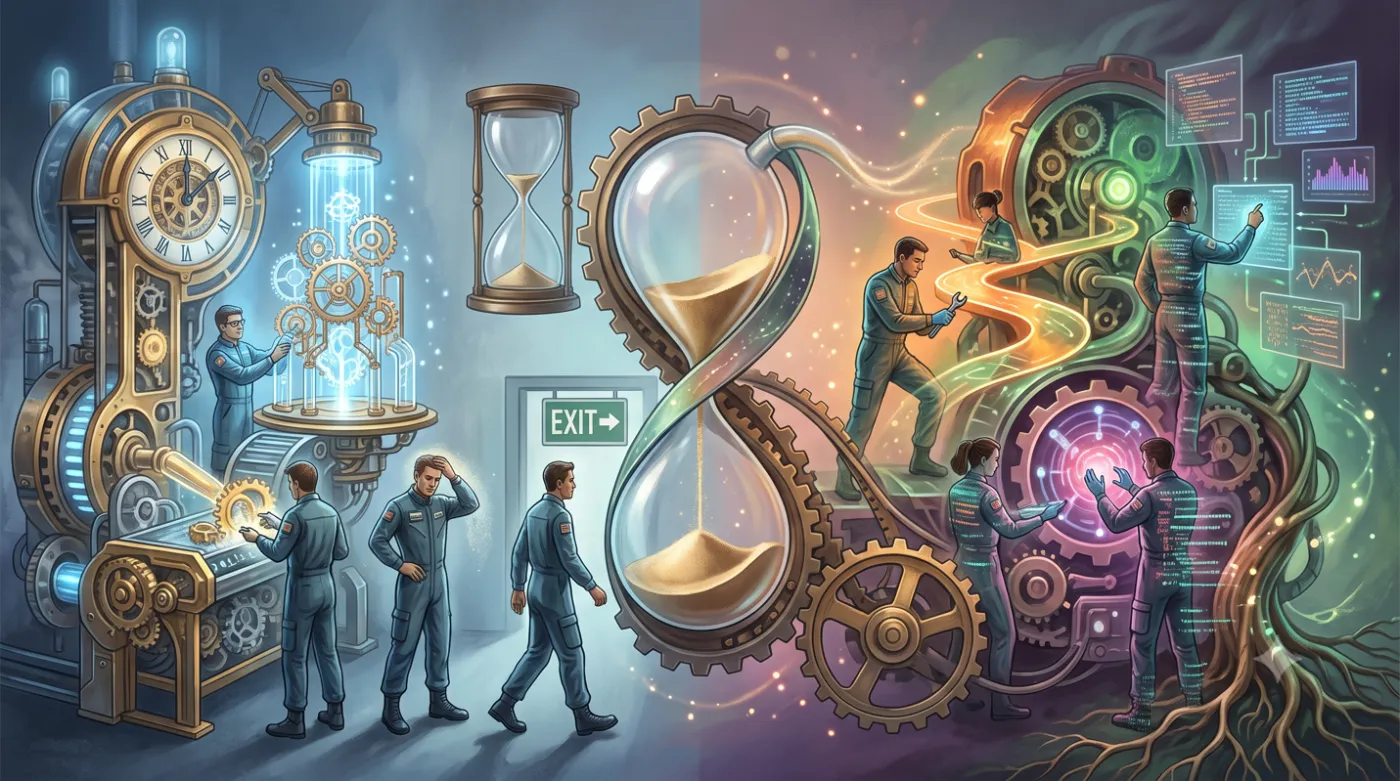
Look at how the newest entrants are choosing to deliver. OpenAI sells its enterprise agent platform through forward-deployed engineers who sit inside the customer's operation rather than shipping software over the wall. Both OpenAI and Anthropic stood up services arms staffed with applied engineers who embed alongside clients. Google puts its own forward-deployed engineers next to partners on complex deployments. Strip away which company is doing it and the pattern is the same: the people who understand the technology best are choosing to stay inside the customer rather than build something and leave.
That is not a go-to-market tactic. It is a signal about the shape of the work. For a channel partner, the operating model that defined the business for thirty years (scope a project, build it, hand it over, invoice, exit, maybe leave a support contract behind) is quietly running out of road. The last article looked at governing the cost of the agentic workforce. This one looks at a larger shift underneath it: what a partner's business actually does is changing from building systems to running them.
Build-and-Exit Was Built for Software That Sat Still
The project model made sense because the thing being delivered held still. You configured an ERP module, integrated a CRM, stood up a reporting stack, and once it was live, it mostly stayed the way you left it. Change came in scoped waves: a new release, an upgrade project, a fresh statement of work. The partner could leave because the system did not need anyone in the room to keep behaving. Value was created at build time and captured on delivery.
An agentic workforce does not hold still. It is a population of agents executing a customer's processes, and it drifts: inputs change, edge cases surface, an upstream system changes a field, a model gets swapped underneath it, an agent finds a path no one designed. The work is never finished being delivered because it is never finished changing. Surveys of the mid-market keep finding the same gap: a large majority of companies now have AI running somewhere, but only a small fraction have it operating reliably across the business. The distance between those two numbers is not a technology gap. It is the absence of anyone whose job is to run the thing after it goes live.
Enter the Embedded Operator
The role that fills that gap is not the old one wearing a new label. A build-and-exit partner sells hours against a scope and leaves when the scope closes. The new partner paradigm, an embedded operator, stays inside the customer's operation and runs the workflow as an ongoing responsibility: monitoring what the agents do, catching the exceptions they cannot, retraining and rerouting as the business changes, and standing behind the result the way an internal function would.
This is the operating-model expression of the spine that has run through the whole series, from the 2026 Channel Forecast onward. A partner does not own the workflow consequence by building a system and hoping it holds; it owns the consequence by being the one who operates the system that produces it. Recall the split from earlier in the series: you can rent the workforce's muscles (the runtime and the harness it runs on) but you never rent its memory: the process logic, the accumulated exceptions, and the accountability for the outcome. The embedded operator is the keeper of that memory. It is the reason the model cannot be handed back to the platform or lifted out by the next vendor, because the part that matters does not live in the software. It lives in whoever has been running it.
It is worth being precise about what this is not. It is not staff augmentation: renting bodies by the day against no particular outcome. Nor is it a traditional managed-services desk, which keeps a static system patched and available. The embedded operator is accountable for what the workflow produces in the customer's business, not merely for uptime. That distinction is the whole difference between selling capacity and owning consequence.
| Dimension | Build-and-exit | Embedded operator |
|---|---|---|
| Unit of delivery | A finished system, handed over | A workflow, run continuously |
| When value is created | At build time, captured on delivery | Over time, while the workflow runs |
| Relationship after go-live | Ends, or drops to support | Deepens; go-live is the start |
| What the customer keeps if the partner leaves | The system | Very little: the operating knowledge left with the partner |
Why This Reaches the SMB-to-Corporate Market
A large enterprise can hire its way into this. It can stand up an internal team whose job is to operate its agentic workforce, and for the largest firms that will often be the right answer. A partner serving the SMB-to-Corporate market (small business up through roughly $1 billion in revenue) is working with customers who cannot. These companies were never going to build an internal operations function for AI any more than they built one for the software they already run; they do not have the bench, and the economics never justified it. The operator role is not a nicety for them. It is the only way the agentic workforce runs at all.
That same fact makes the position durable. A system you build and leave can be maintained by anyone, or replaced at the next renewal. A workflow you operate (where the exceptions, the tuning, and the judgment about what "working" means for this particular business all live with you) is not something the customer can easily take back or hand to someone else. The build-and-exit partner was replaceable the day the project closed. The operator becomes harder to remove the longer it runs, because it is not selling the system; it is being the reason the system keeps working.
The obvious question this raises is how a partner gets paid for running something rather than building it: how the commercial terms change when value accrues over time instead of on delivery. That is the subject of the next article. This one's argument is narrower and comes first: before the terms can change, the operating model has to. The partners that will matter in the agentic era are not the ones that deliver the best project. They are the ones still in the room when the project is over.
The Common Thread
Every article in this series has pointed at the same ground from a different angle: the durable value is not the technology, it is the accountability for what the technology does in a real business. The operating model is where that stops being a slogan and becomes a way of running a company. Building was a thing you finished. Operating is a thing you do. A partner that finishes and leaves is selling something that ends; a partner that stays and runs the workflow is selling something that compounds. The project was always going to end. The workflow is what keeps going, and so is the partner who runs it.
Part of a series
This post is one part of the Insights series, our post-by-post working through of the thesis the 2026 Channel Forecast sets out in full.
Sources
- Forward-deployed and embedded delivery models (reporting on OpenAI's enterprise agent platform sold through forward-deployed engineers, and on the OpenAI and Anthropic services arms staffed with applied engineers embedded in client operations): The Information, Bloomberg, Reuters, TechCrunch.
- Google Cloud's forward-deployed-engineer model embedding alongside partners: Google Cloud blog and channel trade coverage.
- Mid-market AI adoption-versus-operationalization gap (widespread adoption, far narrower share running reliably/at scale across the business): RSM Middle Market AI Survey 2026 and Netrio Mid-Market AI Survey 2026; both are advisory/vendor surveys and treated as directional.
- The shift in professional-services delivery away from the project-and-hours model: CB Insights and general trade coverage.