
Earlier this month Cognizant deepened its Gemini Enterprise practice with Google Cloud: jointly built solutions, a library of reusable agents, and "Frontier Certified Engineers" embedded inside client environments. It is a capable practice and, by the reported numbers, a fast one.
It is also a clean picture of where the whole channel is being pulled: toward standardizing on one ecosystem, top to bottom, because doing so is simply easier than the alternative. Our 2026 Channel Forecast put staying model-sovereign among the six moves it recommends to partners. This article is about why that pull is real, why it is strongest in exactly the place it looks most rational, and why a partner should resist it anyway.
Where the Pull Comes From
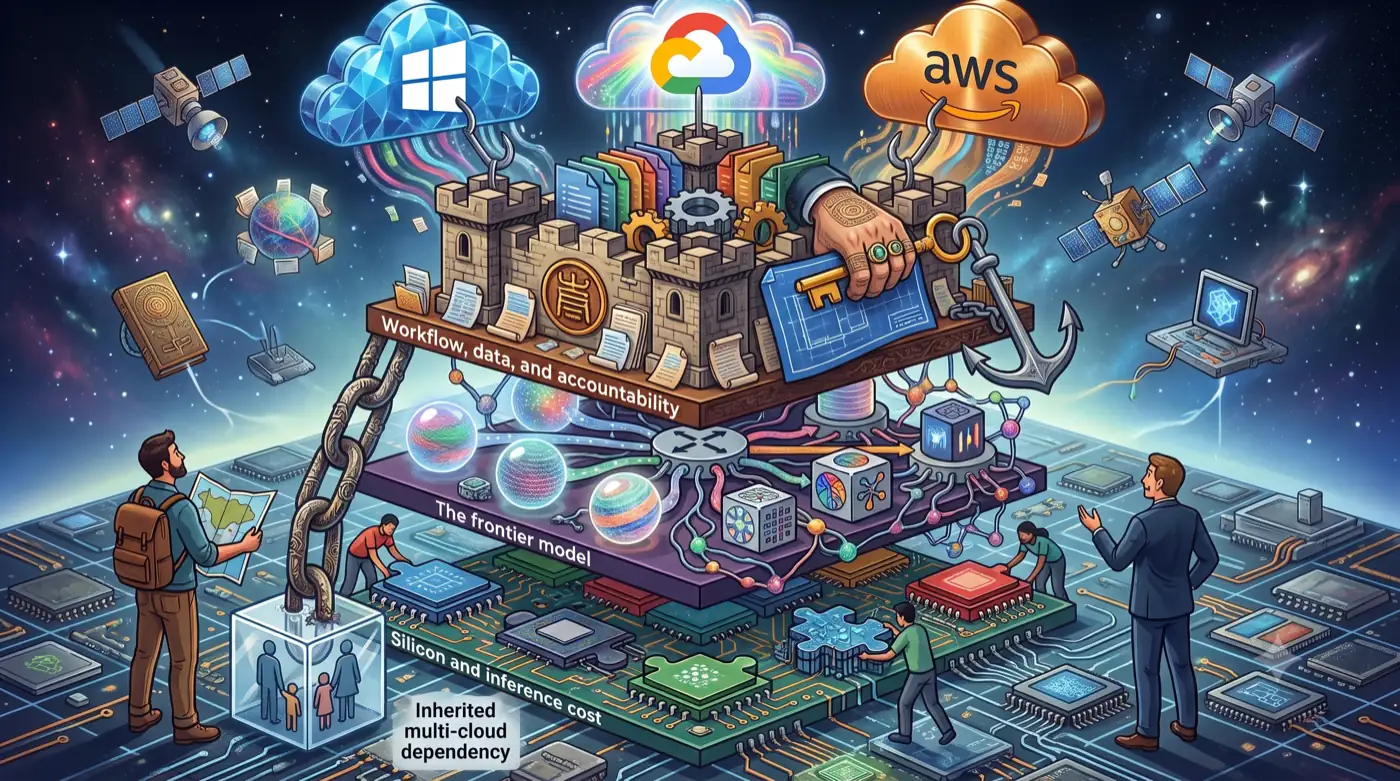
The AI stack has three layers a partner works across: the silicon a workload runs on, the frontier model that does the reasoning, and (on top of both) the workflow the partner owns: the process logic, the data, and the accountability for the result. Almost all the friction a customer ever feels comes from stitching those layers together across different vendors. On that measure the ecosystems are not equal.
For now, only one of them owns both ends at scale. Google runs its own silicon (TPU) and its own frontier model (Gemini), both mature and already the default inside its cloud. Those same TPUs increasingly run rival models too, with Anthropic committing on the order of $200 billion to train and serve Claude on them. So the two levers that decide the economics of the AI era, the cost of inference and the capability of the model, sit under one roof and are shipping today.
The others are racing to the same spot. Microsoft, long reliant on NVIDIA chips and on OpenAI, spent 2026 assembling its own version of the integrated stack: its Maia accelerators and a new in-house model family, MAI. AWS owns its Trainium chip, which Anthropic now trains on, but still rents the model from Anthropic itself. The direction is unmistakable: everyone wants both ends. But they sit at very different stages. Microsoft's silicon has slipped its schedule and its models are new; AWS has the chip but not the mind. Today the friction still favors the one ecosystem where both ends are mature, which a partner feels as a low-friction default on one side and a running negotiation on the others. That the others are now copying the integrated model is the surest sign the ground will keep moving, which is the whole case for not marrying any one of them.
The platforms are making the default lower still. Google recently folded Gemini into its base plans rather than selling it as a separate add-on: the model is now just there, in the product the customer already bought. That is good product design and good for the customer. It also means the path of least resistance is to adopt the embedded model, build on the integrated stack, and never look up. Which is precisely the moment to look up.
The 3-Layer Sovereignty Stack
Model sovereignty is not a slogan about independence. It is a specific discipline applied at each of those three layers: at every layer, keep the ability to pivot if the landscape changes. The table below is the whole argument.
| Layer | The lock-in pull | What staying sovereign looks like |
|---|---|---|
| Silicon and inference cost | Standardize on one cloud's chip and price, and wire your customers' economics to it | Keep workloads portable enough to reprice; never build a practice that only works on one cost curve |
| Frontier model | Adopt the ecosystem's embedded model as the only model, because it is already in the box | Route each task to the model that fits it, and keep a thin abstraction layer between your application and any one model |
| Workflow, data and accountability | Let the platform's tooling hold your process logic and your customer's data | Own this layer outright. It is the one thing that must never become portable to the platform |
This third layer is where the agentic workforce runs: the population of agents that now execute your processes and, increasingly, orchestrate them rather than simply follow them. For clarity, we make the following distinction: a workflow is the path; the agentic workforce is what walks it, and increasingly what chooses it. That is why owning the layer is not the same as owning the tooling. You can rent the workforce's muscles (the runtime and the harness it runs on) but never its memory: the process logic, the exceptions, and the accountability for the result that make the workforce yours. The memory is what must never become portable to the platform.
The first two layers should be sovereign so you can move; the third should be sovereign so you cannot be moved. That asymmetry is the point. The cost and the model are inputs you want the freedom to swap as prices and capabilities shift, and they will shift. The workflow, the domain logic, and the accountability for the result are the assets that make you hard to replace, and they are the ones you never want sitting inside someone else's platform.
Why This Reaches the SMB-to-Corporate Market
A partner serving the largest enterprises can afford a multi-cloud architecture team whose whole job is optionality. A partner in the SMB-to-Corporate band (small business up through roughly $1 billion in revenue) usually cannot, and that is exactly why the pull toward a single stack is so strong here. Standardizing on one ecosystem is not laziness; it is a rational response to thin margins and a small bench. The trap is that the same customer base makes the cost of getting locked in higher, not lower. These customers rarely have the internal team to re-platform later, so a lock-in the partner accepts today becomes a lock-in the customer inherits for years. When the partner is the one deciding which layers stay sovereign, the partner is quietly deciding it on the customer's behalf too.
Sovereignty Is Not Neutrality
There is a wrong way to hear all of this, which is to spread work thinly across three clouds to prove you are independent. That is its own trap: you inherit all the friction of the disaggregated stacks and none of the leverage. Sovereignty is not neutrality. It is entirely consistent to standardize your delivery on the ecosystem that offers the best cost-plus-capability today (and right now the integrated stack has the least to apologize for on that score) while keeping the layer you own portable enough to walk if the economics move. Commit to the stack that best fits your business today, but don't marry it.
The Common Thread
The platforms are competing to make their own model the frictionless default, and the most integrated one is winning that race on convenience. A partner's job is not to bet on which ecosystem wins; it is to stay valuable no matter which one does. That means treating silicon and model as inputs you can swap, and treating the workflow consequence (the outcome, and the accountability for it) as the thing you never hand over. Sell the outcome, own the layer that produces it, and let the platforms fight over the layers beneath it. The partner who marries one model has tied its own value to a decision it does not control. The partner who stays sovereign has kept the only decision that was ever really theirs.
Part of a series
This post is one part of the Insights series, our post-by-post working through of the thesis the 2026 Channel Forecast sets out in full.
Sources
- Cognizant's expanded Gemini Enterprise partnership with Google Cloud, including embedded engineers and reusable agents: PR Newswire, Cognizant investor release (agent counts and deployment-speed figures are company-sourced and treated as directional).
- Gemini folded into base Google Workspace plans and the retirement of standalone Gemini add-ons: vendor and secondary pricing summaries.
- Silicon and frontier-model ownership across the Google, Microsoft and AWS ecosystems (TPU/Gemini, Maia/MAI, Trainium/Anthropic): company disclosures and general industry reporting.
- Microsoft's MAI in-house model family (launched at Build 2026) and its Maia "Braga"/Maia 200 silicon roadmap and reported delays: Microsoft AI, The Next Platform, DataCenterDynamics; model maturity and chip competitiveness are early and treated as directional.