
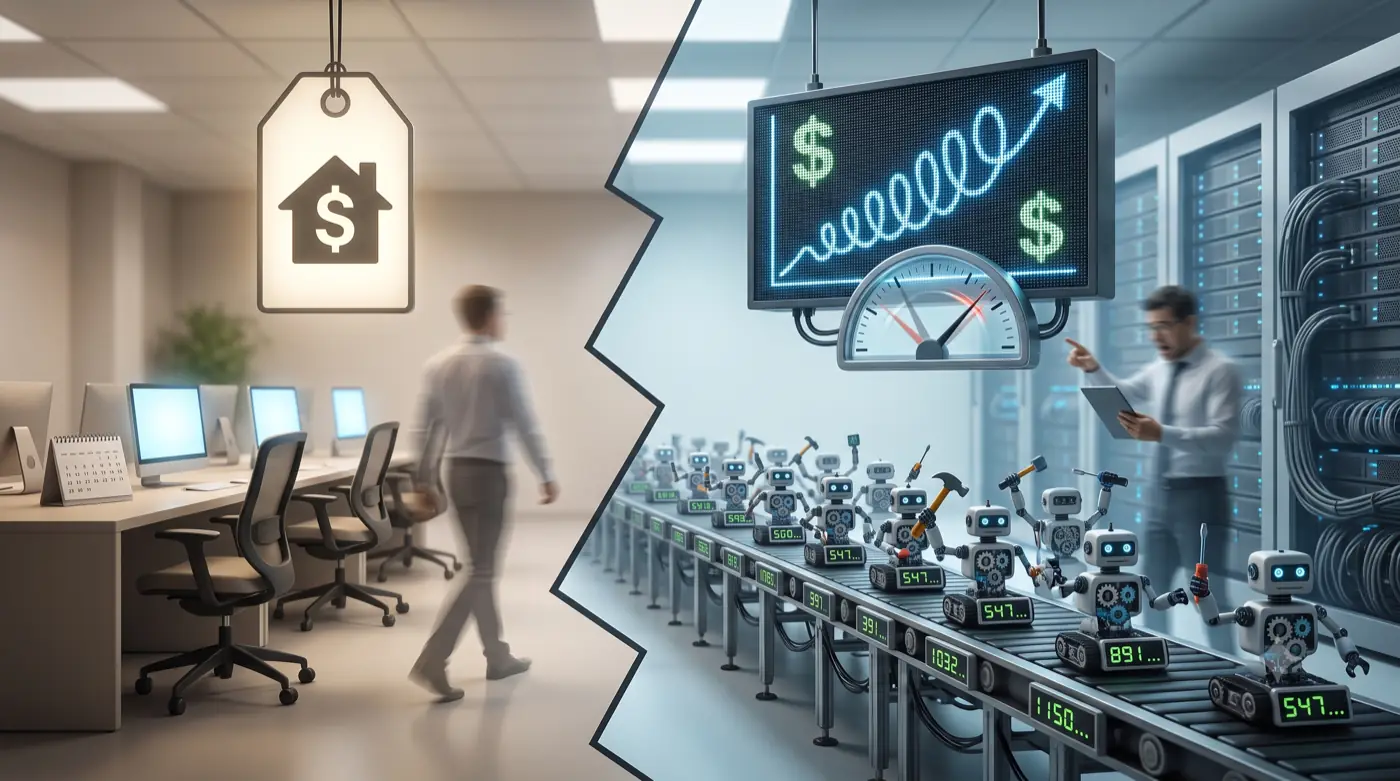
The subsidy that made AI feel free is ending, and it is ending in public. GitHub moved Copilot to token-based billing. Anthropic retired its legacy seat pricing. OpenAI's own leadership has called the company's current pricing "accidental" while it runs deeply cash-negative. The same reckoning is visible on the supply side: Alphabet raised full-year capital spending to roughly $195-205 billion and let free cash flow turn negative to build the inference capacity the era runs on, even as Google Cloud's own operating income more than tripled year over year. That capacity is not a gift. The bill for it is starting to arrive at the customer, priced by the unit consumed.
For a channel partner, this is the point at which the argument of the last article, Don't Marry the Model, turns operational. Once intelligence is metered, the thing a customer actually spends money on is no longer a seat or a license: it is consumption. And consumption, unlike a seat, does not sit still.
It helps to name what is doing the consuming. A workflow is the path; the agentic workforce is what walks it. That workforce, the population of agents now executing a customer's processes, runs up a bill every time it works. The seat was a number a customer could forecast a year out. The workforce is a variable cost that moves with every task it takes on. Almost no one who has hired it is managing it that way.
The Wage Bill Nobody Budgeted For
The consumption is not marginal. A single agent can burn more tokens in an hour than a human user did in a quarter, because reasoning models loop, retry, call tools, and spawn sub-agents. Every one of those steps is metered. Industry commentary now describes per-customer consumption growing at rates that would set off alarms on any other line item. Whatever the exact multiple, the direction is not in dispute.
Most companies have hired this workforce with no payroll system behind it. They bought agents the way they bought seats (a fixed, forecastable number) and got something that behaves like a variable-cost labor force with no budget, no manager, and no timesheet. Where a cost like that goes unwatched, it gets justified by the wrong measure. Productivity reported in tokens consumed is like judging a sales team by the number of calls it dials: it counts effort, not result. The bill, meanwhile, scales with every retry and every agent that never quite reaches its exit condition.
Governing It Is a Service Line, Not a Dashboard Feature
The instinct is to treat this as a tooling problem the platform will solve. It will not, at least not in the customer's favor: the platform meters the consumption and earns on it, so it has no stake in lowering the customer's bill. Governing the wage bill is work that has to be owned inside the customer's operation, and it maps almost exactly onto how a company already governs headcount. The first move is to route the work to the cheapest worker who can do it, since most business tasks do not require a frontier model and a large share run acceptably on smaller or open-weight models at a fraction of the cost. Sending every task to the top of the range is like staffing every job with the most expensive person on the payroll.
The second is the ordinary discipline a controller applies to any variable cost: token budgets by team, hard limits on runaway agent loops, and an alert when a workflow starts consuming out of proportion to what it returns. The third is measurement: reporting cost per outcome rather than cost per token, because a customer that cannot say what a given workflow costs to produce one completed result is flying blind. Even the vendors are shifting the unit of account here: Salesforce now reports "agentic work units," a measure of what agents finish rather than what they burn.
None of this is model-building. It is bookkeeping and discipline applied to a new kind of labor cost, and it is a layer the platform is content to leave to a partner, precisely because the partner is disciplining consumption the platform is paid on.
Underneath all of it, three things changed at once:
| What changes | Before | Now |
|---|---|---|
| What the customer buys | A seat: a fixed and forecastable line item | Metered consumption that moves with every task the workforce takes on |
| Who manages the cost | No one; it was a flat license | A partner governing routing, budgets, and cost-per-outcome inside the customer's operation |
| What the platform supplies | The software | The meter, and no incentive to slow it down |
Where the Cost Curve Is Most Durable
Governing consumption raises a question a partner cannot answer without looking at the stack underneath: whose meter is this, and how stable is the rate? On that measure the ecosystems are not equal. The price of a token is set by two things the customer does not control: the silicon the model runs on and the model itself. The ecosystems are racing to own both, at very different stages.
Google is furthest along: it runs its own chip (TPU) and its own frontier model (Gemini), so the two inputs that determine what inference costs already sit under one roof and can be moved together. Microsoft is now chasing the same position rather than buying both inputs outright. It has put its own inference silicon (Maia) and its own in-house model family (MAI) into the stack, though it still leans on NVIDIA for frontier training and on OpenAI for its top-end capability. AWS owns its Trainium chip but still rents the model from Anthropic. This is not a verdict on any of them. It is arithmetic about who can adjust the cost curve alone and who still has to negotiate it across vendors they do not fully control.
The partner's job is not to pick the winner of that race; the previous article made the case for staying sovereign across all of them. It is to understand that a customer's token bill runs on one of these curves, and that the curve controlled end to end by a single owner has the most room to pass an efficiency through, while the others must assemble it from parts. A partner that governs consumption should read the cost curve as closely as it reads the model's capability, and let the customer see which side of it their workloads are running on. The 2026 Channel Forecast traced the same mechanism one layer down, in the competing infrastructure alliances that keep moving those costs around.
Why This Hits SMB-to-Corporate Hardest
For a company of, say, $5-10 million in revenue running at single-digit margins, one premium workflow left ungoverned can quietly consume a real share of the profit it was meant to create, and these companies run dozens of workflows, not one. The math stops working long before anyone notices, because nothing on the invoice looks like a seat count going up.
A large enterprise answers this by standing up an internal function whose whole job is AI cost discipline. An SMB-to-Corporate customer (small business up through roughly $1 billion in revenue) usually cannot: it has neither the bench nor the tooling to watch a bill that moves by the hour. That is exactly the gap a partner fills. And it is a durable one, because the customer least able to manage its own token bill is also the one least able to remove a partner who does it well.
The Common Thread
Every article in this series has landed on the same ground: the durable value is not the intelligence, it is the accountability for what the intelligence does. Token-cost governance is that principle applied to the meter. The platform will happily sell a customer consumption; it will not sit inside that customer's operation and answer for whether the consumption produced anything worth paying for. A partner that governs the agentic workforce's wage bill by routing its work, budgeting its spend, and tying its cost to real outcomes is selling something that grows more valuable exactly as the meter runs faster. The seat was a number you could forecast. The workforce is a cost someone has to manage. Managing it is the service line.
Part of a series
This post is one part of the Insights series, our post-by-post working through of the thesis the 2026 Channel Forecast sets out in full.
Sources
- The end of subsidized AI pricing (GitHub's shift of Copilot to token-based billing, Anthropic's retirement of legacy seat pricing, and OpenAI leadership describing current pricing as "accidental" amid heavy cash burn): The Information, Bloomberg, TechCrunch, Reuters.
- Alphabet's raised full-year capital-spending guidance (~$195-205B), negative free cash flow, and Google Cloud's operating-income growth: Alphabet Q2 2026 earnings (SEC filing) and CNBC.
- Task-routing economics and open-weight price-performance: The Information, TechCrunch, Reuters.
- Salesforce's "agentic work units" measure: Salesforce, trade coverage.
- Per-customer and per-agent consumption growth figures are drawn from industry commentary and treated as directional.
- Silicon and frontier-model ownership across the Google, Microsoft and AWS ecosystems (TPU/Gemini; Microsoft's Maia inference silicon and its in-house MAI model family alongside continued reliance on NVIDIA and OpenAI; Trainium/Anthropic): company disclosures and general industry reporting; Microsoft's Maia 200 launch and the seven MAI models unveiled at Build 2026 are recent and their cost/benchmark claims are treated as directional pending primary confirmation.